
Ultimate Guide to R&D Tax Credits and Cash Flow
Learn how R&D tax credits boost cash flow, qualify under the IRS 4-Part Test, enable payroll tax offsets for startups, and require strict documentation.

R&D tax credits can help businesses save money by reducing taxes owed and improving cash flow. These credits are available to U.S. businesses working on research and development activities, offering a return of 9%-14% on qualifying expenses. Startups can also offset up to $500,000 annually against payroll taxes, even if they’re not profitable. Recent legislation, like the 2025 "One Big Beautiful Bill Act", allows immediate deduction of R&D expenses, further boosting liquidity. To qualify, activities must meet the IRS’s strict 4-Part Test, and businesses need detailed documentation to claim these credits. Properly utilizing R&D tax credits can provide immediate and long-term financial benefits for businesses of all sizes.
Extend Your Cash Flow Runway with R&D Tax Credits Interview with Ashley Crawford and Tim Hansen
Eligibility and Qualifying Activities for R&D Tax Credits
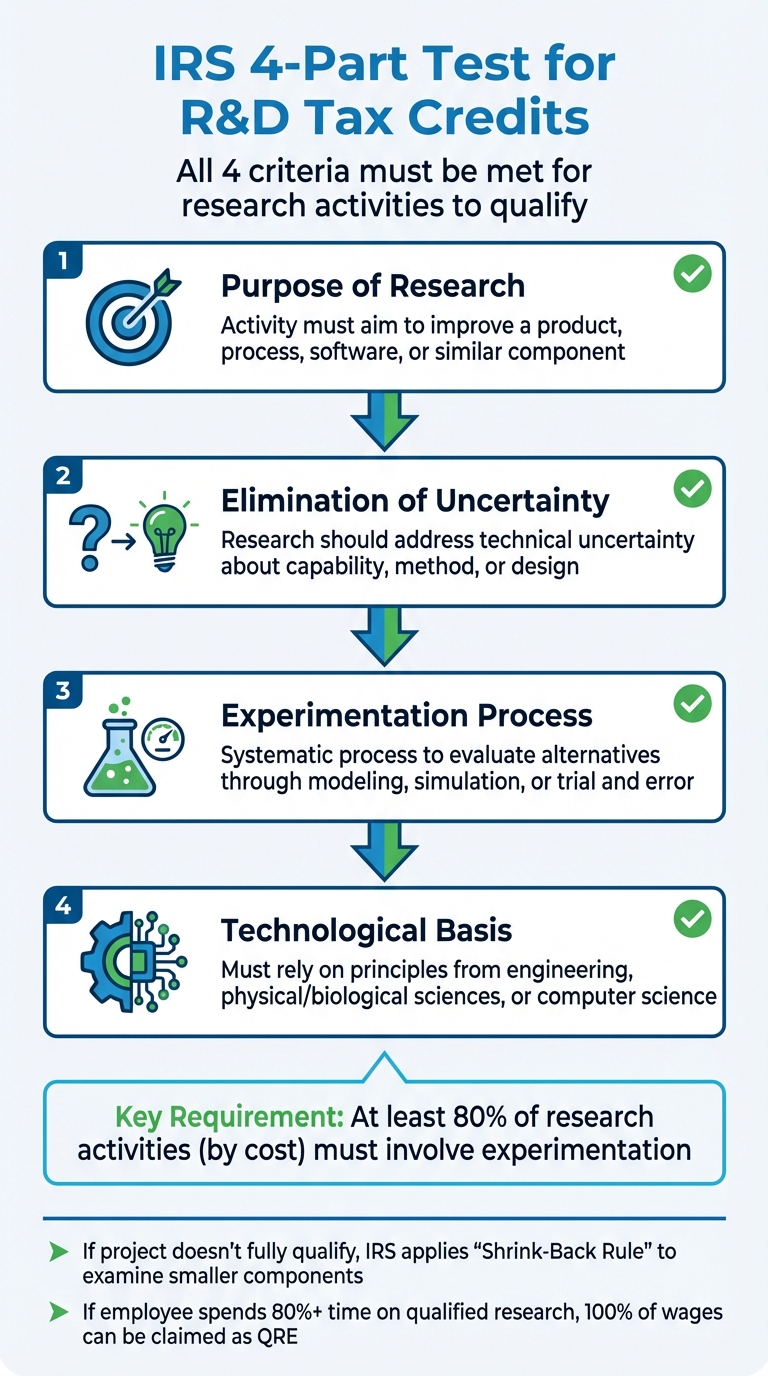
IRS 4-Part Test for R&D Tax Credit Qualification
Key Eligibility Requirements
To qualify for R&D tax credits, research must be conducted within the United States, Puerto Rico, or a U.S. possession - foreign research is not eligible. The One Big Beautiful Bill Act, enacted in July 2025, allows businesses to immediately deduct domestic research expenses, while foreign research expenses must be amortized over 15 years.
For small businesses, significant changes have expanded eligibility. Starting in 2025, the gross receipts threshold increased from $5 million to $31 million, enabling businesses to offset up to $250,000 in payroll taxes annually. Additionally, the Inflation Reduction Act of 2022 doubled this offset to $500,000 for tax years after December 31, 2022. Over a five-year period, the maximum benefit can reach $1.25 million.
To determine whether your research qualifies, the IRS applies its rigorous 4-Part Test.
The IRS 4-Part Test
For research activities to qualify for the R&D tax credit, they must meet all four criteria outlined in the IRS test:
- Purpose of Research: The activity must aim to improve a product, process, software, or similar component.
- Elimination of Uncertainty: The research should address technical uncertainty about capability, method, or design.
- Experimentation Process: A systematic process must be used to evaluate alternatives, such as through modeling, simulation, or trial and error.
- Technological Basis: The activity must rely on principles from engineering, physical or biological sciences, or computer science.
At least 80% of the research activities (measured by cost) must involve a process of experimentation. If the entire project doesn't meet these criteria, the IRS employs the "Shrink-Back Rule", examining smaller components to identify qualifying activities. Additionally, if an employee spends at least 80% of their time on qualified research, 100% of their wages can be claimed as Qualified Research Expenses.
"The combination of these four tests reveals whether a project has conducted qualifying research activities." – Bryan Valencia, Calvetti Ferguson
This structured approach ensures that only projects meeting strict standards qualify for the credit.
Examples of Qualifying Activities
Using the IRS criteria, here are examples of activities that qualify and those that don’t:
- Qualifying activities: Developing new software, designing products, creating prototypes, and improving process performance - provided these involve more than routine efficiency studies.
- Non-qualifying activities: Post-commercialization R&D, customer-specific adaptations, routine quality testing, market research, and studies in social sciences or humanities.
The IRS focuses on the actual work performed, not job titles. To substantiate claims, businesses should keep detailed records, such as payroll data, project timelines, and performance reviews. Obtaining a patent can also serve as definitive proof that the research successfully resolved technical uncertainty.
Cash Flow Benefits of R&D Tax Credits
R&D tax credits can improve cash flow by reducing current tax burdens and increasing liquidity. They provide both immediate relief and long-term financial benefits.
Payroll Tax Offset for Startups
For startups, R&D tax credits can offer quick financial relief through a payroll tax offset. Companies with less than $5 million in gross receipts and no prior gross receipts can apply up to $500,000 annually toward employer-paid Social Security and Medicare taxes. This is particularly helpful for startups that don’t yet have income tax liability.
"The payroll tax credit... is designed to benefit an eligible startup that has little or no income tax liability." – IRS
This offset reduces payroll taxes by 7.65%. To take advantage of this benefit, businesses must file the election on Form 6765 with their original income tax return, as amended returns are not eligible. Once the election is filed, the credit becomes available in the first calendar quarter following the submission of the return.
In addition to payroll tax offsets, R&D credits can also provide critical relief for companies operating at a loss.
Immediate Financial Impact for Loss-Making Firms
The 2025 One Big Beautiful Bill Act reinstated the ability to fully expense domestic R&D costs immediately, eliminating the previous five-year amortization requirement. This change allows businesses to deduct R&D expenses upfront, reducing taxable income and improving liquidity.
"Immediate expensing of domestic R&D is permanently restored - opening meaningful tax-saving opportunities for businesses of all sizes." – Matt Remuzzi, CEO, CapForge
Federal R&D credits generally provide a return of 9% to 14% on every qualified dollar spent. Beyond offering immediate tax relief, unused credits can generate ongoing financial benefits.
Long-Term Benefits Through Credit Carryforward
Unused R&D tax credits can be carried forward for up to 20 years, allowing businesses to offset future tax liabilities. They can also be carried back one year to recover taxes already paid. This flexibility is especially useful for companies in their early, unprofitable stages, enabling them to accumulate credits and apply them as they grow. By consistently claiming these credits, businesses can "bank" tax savings to support their long-term financial strategies.
How to Claim R&D Tax Credits
Claiming R&D tax credits can help improve your cash flow, but it requires careful tracking, documentation, and adherence to filing requirements.
Identifying Qualifying Expenses
Qualified Research Expenses (QREs) typically fall into four main categories:
- Wages: Include wages reported on Form W-2, Box 1, for employees involved in research activities - whether they directly perform, supervise, or support the work.
- Supplies: Cover expendable items like prototypes, chemicals, or testing materials used in the research process.
- Contract Research: Payments to third-party contractors may qualify, though only 65% of these costs are generally eligible.
- Cloud Leasing: Costs for cloud hosting services, such as AWS or Google Cloud, used specifically for R&D purposes.
Certain costs don't qualify, including overhead, fringe benefits, and depreciable assets. To ensure eligibility, each expense must pass the IRS Four-Part Test, which means it must have a permitted purpose, be technological in nature, address technical uncertainty, and involve experimentation. Compare the Regular Research Credit (20%) and the Alternative Simplified Credit (14%) to determine which option offers the best benefit.
Once you've identified qualifying expenses, thorough documentation is critical.
Documentation Best Practices
The IRS requires contemporaneous documentation to support your claim. Use time-tracking tools to connect labor costs directly to specific R&D projects. Maintain detailed records such as logs, payroll data, technical narratives, and receipts for at least six years. For each business component - whether it's a product, process, or software feature - prepare technical narratives that outline uncertainties, alternatives considered, and methods used.
"A taxpayer claiming the credit must retain records in sufficiently usable form and detail to support their claim." – Treasury Regulation 1.41-4(d)
Starting in 2022, the IRS mandates detailed documentation for all business components, including qualified wages, supplies, and contract research expenses.
Filing Requirements and Forms
After identifying and documenting expenses, follow these steps to file your claim:
- File Form 6765 (Credit for Increasing Research Activities) with your annual income tax return to calculate and claim the credit.
- Most taxpayers, except partnerships and S-corporations, must also complete Form 3800 (General Business Credit) to report the credit.
- If you're a qualified small business electing a payroll tax offset, complete Form 8974 and attach it to your quarterly employment tax return (Form 941) for the first quarter after filing your income tax return.
For tax years starting after December 31, 2024, Section G of Form 6765 becomes mandatory. This section requires detailed information about at least 80% of your total QREs or your top 50 business components, ranked by expense amount. Additionally, make the Section 280C election on your original, timely filed return by answering "Yes" or "No" on Item A of Form 6765. Missing this election means you'll need to reduce your R&D expense deduction by the full credit amount, and it cannot be changed on an amended return.
sbb-itb-29ec5e8
Common Mistakes and How to Avoid Them
Businesses often stumble when claiming R&D tax credits, leading to disallowed expenses during IRS audits. These mistakes can directly impact cash flow and even result in penalties. Knowing what to watch out for is key to protecting your claim.
Inadequate Documentation
One of the most frequent reasons R&D claims fail is poor or incomplete documentation. Many businesses try to piece together records after the tax year ends, which weakens their claims and increases the likelihood of an audit. As Kevin Zolriasatain from KBKG points out:
"The more you rely on an IRS auditor to figure out how your documentation supports expenses, the greater the risk exposure."
Relying on year-end documentation can lead to missed expenses and a lower credit value. For example, claiming employee wages without timesheets that tie their hours to specific technical challenges can result in a rejected claim. Similarly, contractor expenses are at risk if there’s no written agreement in place before the research begins. Keep in mind that only 65% of contract research costs typically qualify, and the contract cannot be contingent on the project's success.
To address these issues:
- Use real-time tracking tools to document technical challenges as they happen.
- Conduct quarterly reviews to ensure all qualifying activities are captured.
- Standardize technical narratives to clearly address the IRS’s Four-Part Test.
Next, let’s look at how misclassifying activities can weaken your claim.
Misidentifying Qualifying Activities
Another common error is incorrectly identifying what qualifies as R&D. To meet the IRS’s Four-Part Test, activities must:
- Serve a permitted purpose.
- Be technological in nature.
- Eliminate uncertainty.
- Involve experimentation.
For example, debugging flaws after commercial production begins usually doesn’t qualify, though fixing issues during development might. Similarly, cosmetic changes or routine administrative tasks don’t count as R&D. The IRS also requires that at least 80% of research activities for a business component involve experimentation. Poor wage allocation that doesn’t separate qualifying from non-qualifying tasks can further weaken claims.
The "Shrink Back" Rule can help here. If a broad business component doesn’t meet the qualification criteria, break it into smaller subsystems or techniques until you identify a qualifying component. Be sure to document what was unknown at the start of the project to show how uncertainty was eliminated. Clearly define when R&D ends and routine production begins to avoid confusion.
Overlooking Payroll Tax Offset Eligibility
Beyond documentation and activity classification, missing specific eligibility criteria can also cost businesses savings. Startups, for example, often assume they can’t benefit from R&D credits if they don’t owe income tax. However, the payroll tax offset allows Qualified Small Businesses (QSBs) to apply up to $500,000 annually against employer-paid Social Security and Medicare taxes.
Strict deadlines can cause businesses to miss this opportunity. The payroll tax offset must be elected on a timely filed original income tax return (including extensions). This election can’t be made on an amended return, and the credit only applies to the employment tax return for the first quarter after the income tax return is filed.
To qualify as a QSB, your company must:
- Have less than $5 million in gross receipts for the current tax year.
- Have no gross receipts in any of the previous five years.
Verify your QSB status annually, and ensure your tax and payroll teams file all required forms, including Form 6765 and Form 8974, correctly.
Getting Expert Help with R&D Tax Credits
Navigating R&D tax credits is all about maximizing your benefits while staying prepared for audits. The IRS Four-Part Test, shifting legislation, and increased scrutiny make this process challenging. Specialized providers often uncover 25% to 40% more credit value compared to traditional accounting firms, yet only 30% of eligible businesses actually claim these credits. This highlights the importance of expert guidance.
How Afino Simplifies R&D Tax Credit Claims
Afino removes the complexity from R&D tax credit claims by handling everything for you. They identify qualifying activities that align with IRS standards, ensure all eligible expenses are included, and prepare claims with detailed, real-time documentation to boost your financial returns.
Their fee structure is success-based: 20% of the credit amount, charged only if your business receives the money. This means no upfront costs - payment happens only when you see results. Dan Hurwitz, Cofounder of FoxyAI, shares his experience:
"Afino does all of our accounting, finance, and tax. Their quality of work and attention to detail is top notch. Not only are they easy to work with, but they close our books 5 days after month-end."
Beyond calculating credits, Afino offers strategic advice, helping businesses choose between the Regular Research Credit (RRC) and the Alternative Simplified Credit (ASC) methods. They also coordinate federal claims with state-level programs across 37 states to maximize overall returns.
Benefits of Professional Guidance
Expert guidance doesn’t just simplify the process - it saves time, reduces risks, and ensures you don’t leave money on the table. Professionals keep up with legislative changes, manage updates to IRS Form 6765, and even handle audit representation, saving business owners over 120 hours annually.
Afino integrates seamlessly with your team through tools like Slack or Microsoft Teams, offering real-time support and functioning as an extension of your finance department.
"We get a full team dedicated to our financial management for the cost of less than 1 full-time hire. Couldn't be a better partner for us!"
With federal R&D tax credits covering 5% to 15% of qualified research expenses and startups able to offset up to $500,000 in payroll taxes each year, having expert support ensures your business captures every dollar it’s entitled to.
Conclusion
R&D tax credits have the potential to reshape your business's financial outlook. With over $10 billion available annually and a return of 9%-14% on qualified expenses, these credits provide real cash flow benefits. Yet, surprisingly, fewer than 20% of eligible businesses take advantage of them.
To qualify, businesses must meet strict IRS requirements, but recent legislative changes have made it easier to access these benefits. For startups, the payroll tax offset is especially valuable - offering up to $500,000 annually to offset Social Security and Medicare taxes. This turns what would normally be future savings into immediate cash flow.
Proper documentation is crucial, not only to maximize the credit value but also to withstand IRS audits. With enhanced reporting requirements for Form 6765 coming in 2025, staying compliant is more important than ever.
Specialists in R&D tax credits can often uncover 25%-40% more value, simplify the filing process, and ensure alignment between federal and state claims. Their expertise ensures that businesses claim every dollar they’re entitled to, reinforcing the cash flow benefits outlined here.
When fully utilized, R&D tax credits provide the financial support needed to fuel ongoing innovation. Whether you’re a startup extending your runway or an established company reinvesting in new products, these credits offer a critical advantage. For businesses aiming to unlock their full potential, working with experts like Afino can streamline the process and ensure no opportunity is missed.
FAQs
How can I tell if my business activities qualify for R&D tax credits?
To figure out if your business activities qualify for R&D tax credits, think about whether they involve developing or improving products, processes, software, or techniques. Specifically, these efforts should include experimentation to address technical uncertainties. The work must also be tied to your trade or business and use a structured approach to achieve progress.
Eligible expenses usually include wages for employees directly involved in research, the cost of supplies used in the R&D process, and certain contract research expenses. On the other hand, activities like market research, routine testing, or quality control don’t meet the criteria. Keeping detailed records of your efforts and associated costs is crucial to back up your claim and stay compliant during an IRS review.
If you’re unsure about the process, reaching out to a financial expert can provide clarity and help you make the most of the available benefits.
What records do I need to claim R&D tax credits?
To claim R&D tax credits, having clear and detailed records is crucial. This means keeping thorough documentation of your research activities, including project descriptions, objectives, timelines, and methods. You’ll also need to track expenses tied to qualified research activities (QRAs) and qualified research expenses (QREs). These can include wages, supplies, and costs for contract research.
Examples of useful records include time tracking logs, project reports, technical documentation, and financial statements that directly connect expenses to your research efforts. The IRS places a strong focus on maintaining proper records to back up your claim, particularly if an audit occurs. By staying organized and accurate, you’ll not only make the filing process smoother but also ensure you’re prepared to address any questions or reviews that may come up.
How can startups use the R&D tax credit to offset payroll taxes?
Startups have a great opportunity to boost their cash flow through the R&D tax credit payroll tax offset, even if they don’t owe income taxes. This program lets eligible small businesses use their federal R&D tax credit to directly cut down their payroll taxes - specifically, the employer’s share of Social Security and Medicare taxes.
Recent updates have made this benefit even more appealing. The annual maximum offset has increased to $500,000, doubling the previous cap of $250,000. Plus, the inclusion of Medicare taxes in the offset expands its impact. For early-stage startups, this means reduced payroll tax burdens, allowing them to redirect cash toward ongoing R&D efforts and fueling their growth more effectively.