
How to Reduce Corporate Tax Liability Legally
Legal tax strategies to lower corporate taxes: maximize deductions and credits, leverage depreciation and entity choice, and stay IRS-compliant.

Reducing corporate tax liability legally requires a mix of smart planning, accurate compliance, and leveraging available tax benefits. Here’s a quick breakdown:
- Maximize Deductions: Deduct operating costs, home office expenses, depreciation, and employee benefits. For example, the home office deduction offers $5 per square foot (up to 300 sq ft).
- Claim Tax Credits: Use credits like R&D, energy incentives, and hiring-related credits such as the Work Opportunity Tax Credit to directly lower taxes owed.
- Utilize Depreciation: Take advantage of Section 179 expensing and bonus depreciation, which allow for immediate deductions on qualifying assets.
- Choose the Right Business Structure: S corps and LLCs may reduce overall tax burdens through pass-through taxation and the 20% Qualified Business Income (QBI) deduction.
- Stay Compliant: File taxes on time (penalties for late filings can reach $510) and ensure electronic filing for corporations submitting 10+ returns.
CPA Reveals the 5 BIGGEST Tax Strategies for Business Owners (Ranked)
sbb-itb-29ec5e8
How to Maximize Tax Deductions for Business Expenses
Every tax deduction you claim reduces your taxable income, which can mean significant savings for your business. The IRS allows businesses to deduct expenses that are both ordinary (common in your industry) and necessary (helpful for running your business). Yet, roughly 90% of small business owners overpay on their taxes because they miss eligible write-offs. To avoid this, it’s important to know what qualifies as a deductible expense and to keep thorough records. Let’s dive into some major expense categories to help you make the most of your deductions.
Operating and Administrative Expenses
Everyday operating costs like rent, utilities, office supplies, internet, phone bills, and insurance premiums are fully deductible. Marketing expenses - such as online ads and website hosting - also qualify, along with professional fees for services like accountants, attorneys, and tax preparers.
If you work from home, you may be eligible for a home office deduction. You can choose the simplified method, which allows you to deduct $5 per square foot (up to 300 square feet, with a maximum deduction of $1,500). Alternatively, you can calculate your actual expenses based on the percentage of your home used exclusively for business. Just remember: the space must be used regularly and solely for work purposes. Claiming this deduction can significantly lower your taxable income.
Depreciation and Interest Payments
For assets like equipment, furniture, or vehicles that will last more than a year, you can recover their cost through depreciation over their useful life. Alternatively, Section 179 allows you to deduct the full cost in the year the asset is put into service.
Interest on business loans, credit lines, and business credit cards is also deductible. If you operate on a cash basis, consider making purchases or payments in December to increase your current-year deductions. This strategy can provide immediate tax savings.
Employee Benefits and Travel Costs
Employee-related expenses are another area for deductions. These include wages, payroll taxes, and benefits like retirement plan contributions and health insurance premiums. Business travel expenses are fully deductible, while meals are limited to 50%.
For vehicle expenses, you can either use the standard mileage rate - 70 cents per mile in 2025 (up from 67 cents in 2024) - or deduct actual costs like fuel and repairs. Whichever method you choose, make sure to keep receipts and document the business purpose of each expense to meet IRS requirements.
How to Claim Research and Development (R&D) Tax Credits
If your business is creating new products, improving processes, or developing software, you might qualify for R&D tax credits. Surprisingly, less than 30% of eligible small businesses take advantage of these credits, leaving billions of dollars unclaimed. Every year, U.S. companies claim over $18 billion in R&D credits, with 87% going to businesses earning over $100 million in revenue. Still, small businesses can benefit too, reclaiming between 9% and 14% of every dollar spent on qualified research activities.
You don’t need advanced scientific degrees to qualify. The IRS defines "research" broadly, covering activities like designing new software features, engineering prototypes, or refining manufacturing methods. Even failed projects can qualify - the IRS rewards efforts to resolve technical uncertainty through experimentation.
Eligibility Requirements for R&D Tax Credits
To qualify, your activities must meet the IRS’s Four-Part Test:
- Permitted Purpose: Your work should aim to create or improve a product, process, software, formula, or invention to enhance its functionality, performance, reliability, or quality.
- Technological in Nature: The work must rely on principles from fields like engineering, computer science, biology, chemistry, or physics.
- Elimination of Uncertainty: Your efforts should address uncertainty about achieving a specific design or capability.
- Process of Experimentation: You need to demonstrate systematic testing, modeling, simulation, or trial-and-error to evaluate different solutions.
Qualified Research Expenses (QREs) can include wages for employees directly involved in or supporting R&D, supplies used during the research process (including cloud computing costs for development), and 65% of payments to U.S.-based contractors working on qualified research. If an employee spends at least 80% of their time on qualified research, all of their wages can count as QREs.
However, there are limits. Research conducted after commercial production begins doesn’t qualify, nor does adapting products for specific customers, market research, or any work done outside the United States.
Working with Professional Services to Maximize Claims
Navigating the documentation and compliance requirements for R&D tax credits can be complex. Businesses need to provide detailed proof of technical uncertainty, maintain contemporaneous records, and document their experimentation process. This is where professional services can make a big difference.
For example, Afino specializes in helping businesses identify qualifying activities, prepare claims, and ensure compliance with IRS rules. They charge 20% of the credit received for their services. This can be especially helpful for Qualified Small Businesses (those with less than $5 million in gross receipts), which can apply up to $500,000 of the R&D credit toward payroll taxes - offering much-needed cash flow even if the business has no income tax liability.
Using Bonus Depreciation and Expensing
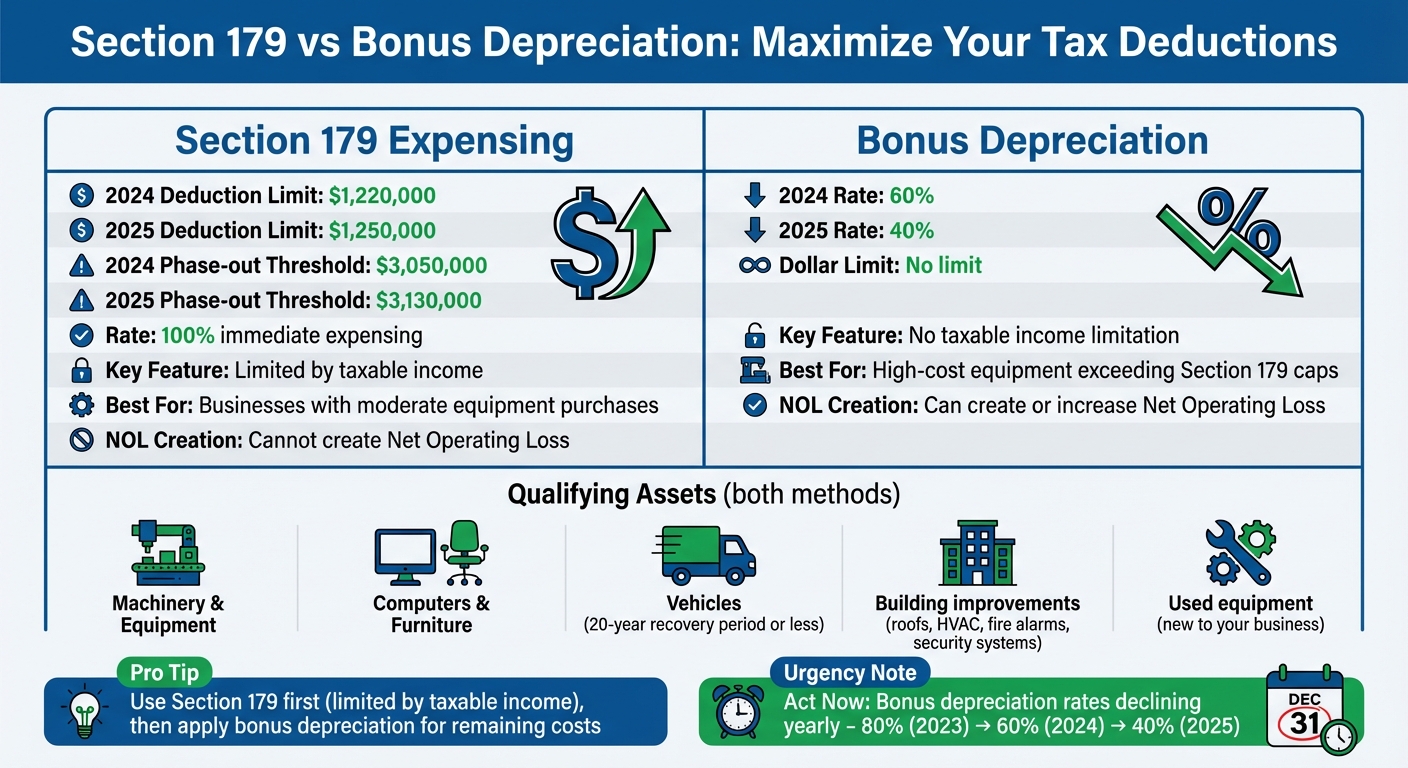
Section 179 vs Bonus Depreciation Tax Benefits Comparison 2024-2025
If you're looking to cut down your taxable income right away, leveraging Section 179 expensing and bonus depreciation can be a game-changer. These strategies allow you to speed up deductions on assets, giving you immediate tax relief.
Bonus Depreciation for Fixed Assets
Bonus depreciation lets you deduct a large percentage of the cost of qualifying assets in the year they become operational. For 2024, the rate is set at 60%, but it drops to 40% in 2025. Unlike Section 179, bonus depreciation doesn’t have a dollar limit, making it ideal for businesses investing in high-cost equipment that exceeds Section 179's caps.
Eligible assets include machinery, equipment, computers, furniture, and vehicles with a recovery period of 20 years or less. Recent updates have expanded this to include certain improvements to nonresidential buildings, like roofs, HVAC systems, fire alarms, and security systems. Even used equipment qualifies, as long as it’s new to your business and wasn’t purchased from a related party.
An added benefit of bonus depreciation is that it can create or increase a Net Operating Loss (NOL), something Section 179 doesn’t allow. This makes it particularly useful if your business is in a low-income year or if you want to carry losses forward to offset future earnings.
Immediate Expensing for R&D Costs
The benefits of quick expensing don’t stop with fixed assets - they also extend to software and R&D investments.
Section 179 allows for 100% expensing of qualifying assets up to $1,250,000 in 2025. However, R&D costs under Section 174 must be amortized. That said, Section 179 does apply to off-the-shelf software used in development work, which can provide immediate tax savings for software-reliant businesses.
To maximize your deductions, use Section 179 first, as it’s limited by taxable income, and then apply bonus depreciation for any remaining qualifying costs.
Timing Asset Purchases for Maximum Tax Benefits
Timing is everything when it comes to asset deductions. To qualify for a deduction in a given tax year, the asset must be placed in service - meaning it’s operational - by December 31. Simply buying equipment in December won’t cut it; it needs to be installed and ready to use.
With bonus depreciation rates dropping each year, timing your purchases has never been more critical. The rate fell from 80% in 2023 to 60% in 2024 and will drop further to 40% in 2025. If you’re planning major equipment investments, accelerating them into the current year could help you lock in higher deductions.
For businesses spending more than $3,130,000 on qualifying property in 2025, Section 179 deductions begin to phase out dollar-for-dollar. In such cases, bonus depreciation becomes essential for maximizing your tax savings on large purchases.
| Tax Year | Section 179 Deduction Limit | Section 179 Phase-out Threshold | Bonus Depreciation Rate |
|---|---|---|---|
| 2024 | $1,220,000 | $3,050,000 | 60% |
| 2025 | $1,250,000 | $3,130,000 | 40% |
Choosing the Right Business Entity Structure
Your business structure plays a key role in shaping tax obligations, income reporting, and eligibility for deductions. Selecting the right entity not only impacts these factors but also complements the tax savings achieved through deductions and credits.
Tax Differences Between C Corp and S Corp
C corporations are taxed at a flat 21% on profits. However, they face double taxation - once at the corporate level and again when dividends are taxed on individual returns.
"The main advantage of the S corp over the C corp is that an S corp does not pay a corporate-level income tax. So any distribution of income to the shareholders is only taxed at the individual level."
– Jennifer Woodside, Assistant Manager, Customer Service, Wolters Kluwer
S corporations, on the other hand, are pass-through entities. This means profits and losses are reported directly on shareholders’ personal tax returns. If the business incurs losses in its early years, shareholders can deduct those losses on their personal returns to offset other income.
For S corp owners actively involved in the business, income can be divided between a reasonable salary - subject to the 15.3% self-employment tax - and distributions, which are not subject to self-employment tax. This approach helps reduce the overall tax burden compared to treating all income as self-employment earnings.
S corporations come with certain restrictions: they are limited to 100 shareholders, all of whom must be U.S. citizens or residents, and they can issue only one class of stock. In contrast, C corporations have no such restrictions, making them more suitable for businesses seeking venture capital or planning to go public.
| Feature | C Corporation | S Corporation |
|---|---|---|
| Federal Income Tax | 21% at the corporate level | Pass-through to shareholders |
| Double Taxation | Yes (corporate and dividend levels) | No (individual level only) |
| Shareholder Limit | Unlimited | Maximum 100 |
| Stock Classes | Multiple allowed | One class only |
| Loss Deductions | Not available to shareholders | Deductible on personal returns |
Qualified Business Income (QBI) Deduction
The structure you choose also determines eligibility for key tax benefits like the Qualified Business Income (QBI) deduction. This deduction allows owners of S corps, LLCs, partnerships, and sole proprietorships to deduct up to 20% of their qualified business income.
Under the One Big Beautiful Bill Act, the QBI deduction will include a minimum deduction of $400 starting in 2026 for taxpayers earning at least $1,000 in active QBI. Importantly, this benefit applies whether you itemize deductions or take the standard deduction.
For businesses classified as a Specified Service Trade or Business (SSTB) - fields like law, health, accounting, or consulting - the deduction phases out when taxable income exceeds $197,300 for single filers or $394,600 for married couples filing jointly in 2025. It is completely eliminated at $247,300 (single) or $494,600 (married filing jointly). For non-SSTB businesses surpassing these thresholds, the deduction may be further limited based on W-2 wages paid or the unadjusted basis of qualified property. Increasing W-2 wages can help maximize this deduction.
Taking Advantage of Energy and Hiring Tax Credits
Energy and hiring tax credits offer a direct way to reduce your tax bill. Together with deductions and other strategies, these credits provide immediate financial relief. Let’s explore how renewable energy and hiring credits can help lower your tax liability.
Renewable Energy Tax Credits
Investing in clean energy can lead to considerable tax savings. For instance, the Clean Electricity Production Credit (Section 45Y) rewards facilities placed in service after December 31, 2024. Smaller facilities producing less than 1 megawatt can earn 1.5 cents per kilowatt hour if they meet specific wage and apprenticeship requirements. Without meeting these standards, the credit drops to 0.3 cents per kilowatt hour. Facilities using domestically produced steel, iron, and other materials can qualify for an extra 10% credit boost.
The Residential Clean Energy Credit (Section 25D) allows homeowners to claim 30% of the costs for installing solar panels, wind turbines, geothermal heat pumps, or battery storage systems through 2032. If your home is used for business purposes less than 20% of the time, you can claim the full credit. However, if business use exceeds 20%, the credit applies only to the non-business portion. While this credit is non-refundable, any unused amount can be carried forward to future tax years. Keep in mind, the credit percentage will drop to 26% in 2033 and 22% in 2034, so acting sooner can maximize your savings.
Building owners can also benefit from the Energy Efficient Commercial Buildings Deduction (Section 179D), which provides deductions for improving energy efficiency in systems like HVAC, lighting, and building envelopes by at least 25%. Additionally, contractors building energy-efficient homes can claim up to $5,000 per home. For tax-exempt or government entities, "elective pay" allows them to receive the full value of energy credits as direct payments, though this requires pre-registration with the IRS.
Hiring and Workforce Development Tax Credits
Hiring credits are another way to reduce taxes while supporting workforce development.
The Work Opportunity Tax Credit (WOTC) provides savings when you hire individuals from targeted groups, such as qualified veterans or those unemployed for 27 weeks or longer. The credit amount is based on the wages paid to eligible employees, directly lowering your tax liability.
Additional hiring-related credits include the FICA Tip Credit, Indian Employment Credit, and Empowerment Zone Employment Credit.
For manufacturers investing in clean energy, the Advanced Energy Project Credit offers substantial benefits. This program, funded with $10 billion under the Inflation Reduction Act, reserves $4 billion specifically for projects in designated energy communities. Projects that meet wage and apprenticeship standards qualify for a 30% credit on eligible investment costs, while those that don’t meet these standards receive only 6%. Most hiring and energy credits fall under the General Business Credit and can be claimed together using Form 3800.
Working with Professional Services for Tax Compliance
Tax compliance has become increasingly complex as the IRS steps up enforcement efforts. With an $80 billion funding boost spread over 10 years - more than half of it allocated for audits and enforcement - businesses are under greater scrutiny than ever before. This means handling filings, payroll taxes, and year-end reports demands a high level of accuracy and attention to detail.
For companies with remote employees, managing payroll tax withholding across multiple states adds another layer of complexity. Each state comes with its own set of rules, including registration requirements, withholding rates, and filing deadlines. Professional services can help you navigate these challenges, ensuring compliance in every state where your employees work. Solutions like Afino's Corporate Tax plan are designed to integrate these needs with ongoing support, making the process smoother and more manageable.
Afino's Corporate Tax plan, priced at $2,400 annually, provides a range of services to keep your business on track. These include federal and state tax filings, Delaware Franchise tax management, 1099-NEC preparation, and expert compliance guidance. Beyond meeting filing requirements, the service also helps identify deductions and credits throughout the year. Plus, the fees you pay for tax preparation services are considered deductible business expenses.
Staying ahead of tax obligations requires year-round planning. Reviewing payroll withholdings and quarterly estimates regularly can help you avoid underpayment penalties. By adopting proactive strategies, you can take advantage of opportunities like the Work Opportunity Tax Credit and maximize deductions throughout the year.
Conclusion
Reducing your tax bill legally involves taking action on multiple fronts. Start by maximizing deductions - these can include everything from operating costs and home office expenses to business mileage at 70 cents per mile. Don’t overlook tax credits like the R&D Tax Credit or the Work Opportunity Tax Credit, which offer direct savings. Shockingly, about 90% of business owners miss out on potential savings by failing to claim eligible expenses.
Selecting the right business entity plays a big role in your tax strategy. Whether you operate as a C-corp, S-corp, or LLC, the structure you choose impacts your tax rates and the deductions you can claim. For example, pass-through entities may qualify for the 20% Qualified Business Income deduction and lower self-employment taxes. Additionally, take advantage of tools like Section 179 and bonus depreciation - currently set at 100% for assets placed in service through January 19, 2025, under the One Big Beautiful Bill Act - to deduct large equipment purchases right away. These structural decisions, paired with forward-thinking strategies, can create a solid foundation for minimizing taxes.
"Proactive tax planning is a powerful catalyst for growth and stability." – CorpifyInc
Planning consistently is far more effective than scrambling at the last minute. Regularly reassess your business structure, strategically time major purchases, and keep your financial records clean by maintaining separate business accounts. Retirement plans like a Solo 401(k) or SEP IRA are another smart move - contributions can reduce your taxable income while helping you save for the future, with limits reaching up to $70,000 in 2025.
To put these strategies into action, working with a tax professional is key. They can help you navigate complicated rules, like multi-state payroll requirements, and prevent costly penalties, which can climb as high as 25% on unpaid taxes. For example, Afino’s Corporate Tax plan - priced at $2,400 annually - offers comprehensive support, including federal and state filings and ongoing deduction management. With expert guidance, you can take full advantage of every opportunity to save while staying compliant.
FAQs
What are some commonly overlooked tax deductions for small businesses?
Many small businesses overlook potential tax deductions simply because they’re unaware of them or fail to maintain proper records. Here are some common deductions that often go unnoticed:
- Home office expenses: If you dedicate a portion of your home exclusively for business purposes, you might qualify for a deduction.
- Business vehicle expenses: Whether you track mileage or actual costs like gas and maintenance, driving for business can be deductible.
- Startup and organizational costs: Expenses tied to getting your business off the ground may be deductible or eligible for amortization.
- Depreciation: Items like equipment, furniture, or software can often be depreciated or deducted under Section 179.
- Retirement plan contributions: Contributions to plans such as a SEP-IRA or Solo 401(k) can reduce your taxable income.
- Health insurance premiums: If you’re self-employed, you may be able to deduct the cost of your health insurance premiums.
- Professional development: Expenses for courses, certifications, or training that enhance your business skills are often deductible.
- Utilities and communication: Costs for internet, phone, and other business-related services can usually be written off.
These deductions are frequently overlooked because they seem minor, go untracked, or aren’t recognized as eligible. To avoid missing out, keep detailed records, like receipts and mileage logs, throughout the year. This not only helps you claim all qualifying expenses but also ensures compliance with tax laws. For accurate guidance, consult a tax professional or review IRS guidelines tailored to small businesses.
How can I find out if my business activities qualify for R&D tax credits?
To figure out if your business activities qualify for R&D tax credits, you’ll need to apply the IRS’s four-part test for "qualified research." Here's what to look for:
- The work should aim to develop or improve a product, process, software, technique, or formula, focusing on better performance, quality, or cost reduction.
- There must be technological uncertainty, meaning the outcome or the method for achieving it isn’t obvious and requires experimentation.
- The activities should involve a systematic process of experimentation, such as testing, modeling, or trial-and-error approaches.
- The research must be grounded in hard sciences like engineering, physics, or computer science. This excludes market or business research.
Once you’ve confirmed your activities meet these requirements, the next step is to make sure your expenses qualify as Qualified Research Expenses (QREs). These usually include wages, supplies, and contract research costs directly tied to the eligible activities. Keep thorough records of your projects - this means documenting hypotheses, testing procedures, results, and related costs (like timesheets, invoices, or contracts). These details are critical for supporting your claim.
If your activities meet the criteria and you can back them up with proper documentation, you’re likely eligible for the credit. Don’t forget to include this information when filling out Form 6765 with your corporate tax return.
What are the main tax differences between S corporations and C corporations?
S corporations and C corporations are distinct in how they handle taxation and the benefits they offer to businesses and their owners.
S corporations operate as pass-through entities. This means their profits, deductions, and credits flow directly to shareholders, who report them on their personal tax returns. This setup helps avoid the double taxation seen with C corporations, where income is taxed at the corporate level (a flat 21%) and again when distributed as dividends. On top of that, shareholders of S corporations may benefit from the Qualified Business Income (QBI) deduction, which can reduce taxable income by up to 20%.
C corporations, in contrast, offer some advantages when it comes to deductions. They can write off a broader range of business expenses, including employee benefits and retained earnings, to lower their taxable income. Additionally, C corporations allow for unlimited shareholders, including foreign investors, and offer the option for multiple stock classes. This makes them a better fit for businesses focused on raising capital or attracting diverse investors. However, profits distributed as dividends are taxed twice - once at the corporate level and again at the shareholder level.
Deciding between an S corporation and a C corporation boils down to your business priorities. If reducing shareholder taxes is key, an S corporation might be the right choice. But if flexibility in ownership and raising funds is more important, a C corporation could be a better fit.