
CFO vs Controller: Which Does Your Business Need?
Pick the right finance leader: Controllers stabilize accounting; CFOs drive strategy — hire based on revenue, growth stage, and funding needs.

When your business grows, managing finances becomes more complex. Should you hire a Controller or a CFO? Here’s the quick answer:
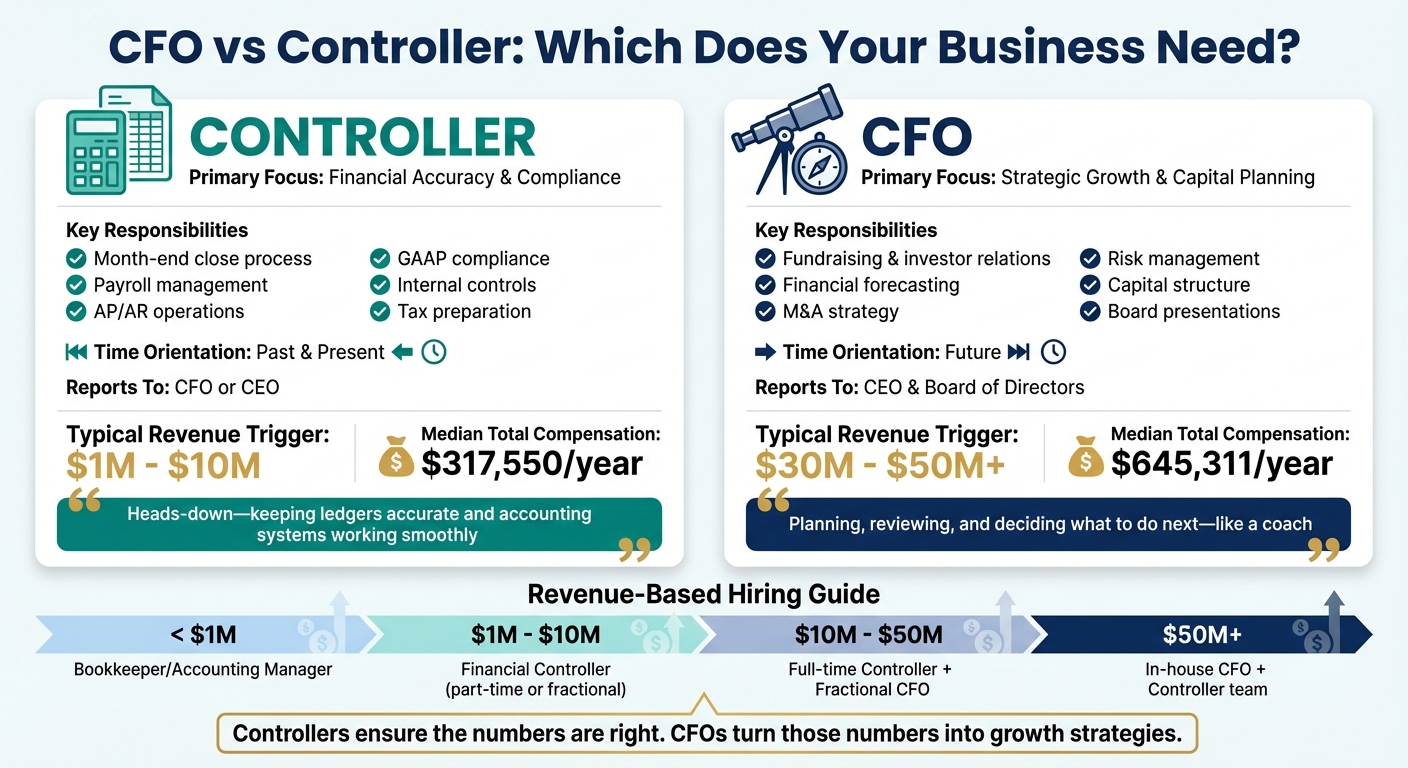
- Controllers handle the day-to-day accounting, ensuring accurate financial records, compliance, and efficient processes. They focus on the past and present.
- CFOs focus on future planning, fundraising, and high-level strategy. They guide growth, manage risks, and make big-picture financial decisions.
When to hire:
- Controller: Businesses earning $1M–$10M annually need a Controller for financial accuracy and compliance.
- CFO: Companies surpassing $30M–$50M in revenue or preparing for major decisions like fundraising or expansion benefit from a CFO’s strategic leadership.
Costs: Controllers earn $213,916–$315,280 annually, while CFOs command $353,972–$535,409. Fractional CFO services can offer expertise without full-time costs.
Quick Comparison:
| Role | Focus | Revenue Trigger | Key Tasks |
|---|---|---|---|
| Controller | Financial accuracy | $1M–$10M | Month-end close, payroll, compliance |
| CFO | Growth and strategy | $30M–$50M+ | Fundraising, forecasting, risk management |
Choosing the right role depends on your revenue, growth stage, and financial needs. Keep reading to understand their responsibilities and how they work together.
CFO vs Controller: Key Differences, Responsibilities, and When to Hire
CFO vs. Controller | What Are The Differences In Terms Of Tasks, Pay & Education
sbb-itb-29ec5e8
What Does a Controller Do?
A Controller plays a key role in managing a company’s accounting operations, bridging the gap between routine bookkeeping and strategic financial oversight. Their main goal? Keeping financial records accurate, compliant, and delivered on time. Controllers oversee the month-end close process, producing critical financial reports like income statements, balance sheets, and cash flow statements - tools that guide executive decision-making. They also design and maintain internal controls to prevent fraud, catch errors, and protect the company’s assets. On top of that, they handle day-to-day operations like accounts payable, accounts receivable, payroll, bank reconciliations, and invoice approvals.
"Controllers are 'heads-down' - working to keep ledgers accurate and accounting systems working smoothly, analyzing variances, and balancing debits and credits",
explains Kristina Russo, CPA, MBA.
During tax season or audits, Controllers take center stage, acting as the primary liaison to ensure the company complies with Generally Accepted Accounting Principles (GAAP) and tax regulations.
Here’s a closer look at the key responsibilities that define a Controller’s role.
Main Responsibilities of a Controller
Controllers focus on three key areas: accuracy, compliance, and operational efficiency. They manage the general ledger and chart of accounts, ensuring every transaction is properly recorded. During the monthly close process, Controllers consolidate financial data to produce GAAP-compliant financial statements.
They also establish and enforce accounting policies, such as expense approval workflows and vendor onboarding procedures, to maintain regulatory compliance and prevent financial errors. Budget preparation is another big part of the job - Controllers gather historical data and track variances between actual and projected spending to keep finances on course.
For example, in 2024, Melissa Skalla, Controller at Teguar Computers, introduced the BILL accounts payable automation platform. This change saved her five hours each week, giving her more time to focus on strategic cash-flow forecasting.
Controllers are also the go-to experts for accounting technology. They implement automation tools for accounts payable and receivable, reducing manual errors and speeding up reporting cycles. Additionally, they work closely with department managers to educate teams about accounting policies and ensure everyone follows proper financial procedures.
When Your Business Needs a Controller
As businesses grow, the need for a Controller becomes more apparent. Many companies hire their first full-time Controller once annual revenue exceeds $5 million. However, businesses generating $1 million or more in revenue may benefit from fractional Controller support, especially if they require audited financial statements for investors, partners, or banks. It’s time to bring in a Controller when basic bookkeeping no longer provides the financial clarity needed for decision-making - like when cash flow issues persist or profits fail to align with bank balances. Rapid growth can also highlight the need for standardized financial reporting and stronger internal controls.
The demand for Controllers is on the rise. According to the Bureau of Labor Statistics, financial manager roles, including Controllers, are expected to grow by 17% between 2023 and 2033 - a much faster rate than average. In 2025, the average annual salary for a Controller was $112,770, with total compensation, including bonuses, reaching a median of $156,000. For companies with annual revenues between $1 million and $10 million, hiring a fractional or part-time Controller can provide high-level financial oversight without the cost of a full-time executive.
Understanding the Controller’s role lays the groundwork for exploring how CFOs contribute strategic value.
What Does a CFO Do?
A Chief Financial Officer (CFO) focuses on shaping a company’s long-term strategy rather than handling everyday accounting tasks. While Controllers are tasked with managing historical financial data and ensuring accuracy, CFOs look to the future - crafting multi-year forecasts, evaluating growth opportunities, and steering significant business decisions. They act as key strategic advisors to the CEO and board, translating financial information into actionable insights.
CFOs also play a pivotal role as the company's financial representative to external stakeholders like investors, banks, and board members. They oversee fundraising efforts, manage the balance between debt and equity, and develop risk management frameworks to handle issues such as currency fluctuations, interest rate risks, and fraud prevention.
Take James Hardy, CFO at SAM Construction Group, for example. In 2025, he introduced a streamlined payment system using Ramp, which enabled the company to secure early-payment discounts of 1% to 2%, saving millions on high transaction volumes. Similarly, Quazi Khaled, CFO at Gardyn, successfully navigated rapid growth by using the BILL platform to automate approval processes for a fully remote team. This allowed Gardyn to scale operations without increasing administrative costs. These examples demonstrate how CFOs can drive cost savings and operational efficiency.
In terms of compensation, the median annual base salary for a CFO in the United States was $436,142 in 2025, with total earnings, including bonuses, averaging $645,311. Now, let’s break down the core responsibilities that set CFOs apart.
Main Responsibilities of a CFO
CFOs are responsible for creating long-term financial forecasts, identifying risks and opportunities, conducting cost-benefit analyses for major initiatives, and overseeing mergers and acquisitions to enhance shareholder value.
They also lead efforts to secure funding, whether through venture capital rounds, debt negotiations, or partnerships with private equity firms. Additionally, CFOs provide strategic advice on critical decisions like pricing strategies, real estate investments, and compensation plans to attract and retain top talent.
Risk management is another cornerstone of their role. CFOs design frameworks to address currency and interest rate risks, implement internal controls to combat fraud, and ensure the company has adequate insurance coverage. As the public face of the company’s financial operations, they prepare board presentations and transform complex financial data into compelling stories for stakeholders like shareholders and lenders.
"Ramp gives us one structured intake, one set of guardrails, and clean data end‑to‑end - that's how we save 20 hours/month and buy back days at close",
says David Eckstein, CFO at Vanta.
In 2024, Christy O'Neil, CFO of the nonprofit The Life Link, used automation to strengthen internal controls for program audits. This move eliminated fraud risks and allowed the organization to pass multiple audits annually without needing additional finance staff.
When Your Business Needs a CFO
Most companies bring in their first full-time CFO when annual revenues approach $50 million. However, investor-backed businesses might hire one earlier, around the $30 million mark. The demand for CFO expertise often arises sooner if revenue growth exceeds 20% annually or the company grows to 100 employees. At these points, financial complexities can surpass what Controllers and accounting managers can handle.
Fundraising is another clear signal that it’s time for a CFO. Whether raising venture capital, securing loans, or preparing for an IPO, investors expect sophisticated financial projections and a strategic leader who can articulate the company’s growth story. CFOs are also critical during mergers, acquisitions, and exit planning, using their expertise in valuation, due diligence, and deal structuring to protect shareholder interests.
For businesses entering new markets, launching new product lines, or managing multiple entities, a CFO can model financial scenarios, evaluate risks, and ensure that the company’s capital structure supports its growth plans. Fast-growing startups often face challenges like cash flow management, pricing strategies, and compensation planning - areas where CFO guidance becomes indispensable.
For smaller businesses generating between $1 million and $10 million in revenue, choosing between a fractional CFO vs full-time CFO can be a smart move. This approach provides access to high-level financial expertise without the expense of a full-time executive, making it an ideal solution during growth phases, fundraising efforts, or significant operational shifts.
CFO vs Controller: Main Differences
CFOs focus on shaping the company's strategic future, while Controllers ensure that historical records are accurate and comply with GAAP standards. As Ampleo puts it, "If business were a game of football, the controller would be the scorekeeper... the CFO is like the coach - planning, reviewing film, and deciding what to do next."
The roles they play within an organization are distinct. The CFO operates at the C-suite level, reporting directly to the CEO and Board of Directors, with authority over all financial decisions and capital allocation. In contrast, the Controller, typically a director-level position, reports to the CFO (or the CEO in smaller companies) and oversees the daily operations of the accounting department.
A real-world example highlights this difference. In May 2025, Tipalti CEO and Co-Founder Chen Amit explained why the company brought on Sarah Spoja as its first CFO. They needed someone capable of identifying growth opportunities, meeting specific fundraising metrics, and quantifying total customer acquisition costs - tasks that go well beyond the Controller’s traditional accounting responsibilities.
To better understand their distinct responsibilities, let’s compare them side by side:
Side-by-Side Comparison
| Dimension | Controller | CFO |
|---|---|---|
| Primary Focus | Ensuring historical accuracy and compliance | Driving strategic growth and managing capital planning |
| Reporting Relationship | Reports to CFO (or CEO in smaller firms) | Reports to CEO and Board of Directors |
| Key Duties | Month-end close, payroll, AP/AR, internal controls, GAAP compliance | Fundraising, M&A, investor relations, FP&A, capital structure |
| Required Skills | Technical accounting, audit preparation, tax compliance, CPA/CMA | Strategic leadership, capital markets expertise, risk management, MBA/CFA |
| Typical Revenue Trigger | $1M – $10M | $30M – $50M+ |
| Daily Task Example | Completing the month-end close process | Evaluating market trends for a potential acquisition |
| External Face | Works with auditors and tax authorities | Engages with investors, banks, and board members |
| Median Base Salary (U.S.) | $252,925 | $436,142 |
These differences make it easier to determine which role is better suited to your company’s current stage of growth and financial complexity. Together, the CFO and Controller form a team that ensures both operational accuracy and forward-looking financial strategy, driving the organization toward success.
How CFOs and Controllers Work Together
In larger companies, the CFO oversees the entire finance function, while the Controller focuses on managing the day-to-day accounting operations. This setup ensures a smooth workflow where accurate financial data feeds into strategic decision-making. The Controller typically reports directly to the CFO, acting as the head of the accounting team. This structure avoids overlap, allowing the Controller to concentrate on execution while the CFO drives broader financial strategy.
Their collaboration can be thought of as a "data-to-insight" process. The Controller is responsible for producing precise financial statements and historical data, while the CFO interprets this information to uncover the bigger picture - essentially, the "story behind the numbers."
How Responsibilities Are Split
The Controller’s role is rooted in the operational side of finance. Tasks like payroll processing, managing accounts payable and receivable, month-end closings, and ensuring compliance with GAAP fall squarely under their purview. Their focus is on keeping the financial records accurate and reflecting the company's performance correctly.
On the other hand, the CFO takes a strategic approach. Using the reports and data provided by the Controller, the CFO identifies inefficiencies, evaluates market conditions, and crafts plans for growth.
Budgeting and forecasting are areas where the two roles work closely. The Controller provides detailed variance analyses, explaining the differences between actual results and budgets. The CFO uses these insights to model future financial projections and refine the company’s direction. This division of labor allows the Controller to zero in on past performance, while the CFO looks ahead to future opportunities.
Together, this partnership of operational precision and strategic vision creates a strong foundation for determining which role is most aligned with your business needs.
Which Role Does Your Business Need?
Deciding between a CFO or a Controller for your business comes down to two key factors: revenue milestones and operational demands. These benchmarks often guide the timing of such hires. For example, many companies bring on a part-time Controller once they reach $1 million in annual revenue, transitioning to a full-time Controller by the $10 million mark. A full-time CFO usually becomes necessary when revenue hits $50 million, though investor-backed businesses might need one earlier - closer to $30 million.
Signs that you might need a Controller include delays in closing the books each month or inconsistent financial reporting. On the other hand, if you're tackling big decisions like pricing strategies, hiring plans, or market expansion without clear financial forecasts - or preparing for fundraising, mergers, or even an IPO - it’s time to consider hiring a CFO.
Factors to Consider
Both where your business is now and where it's headed play a big role in this decision. A company experiencing rapid growth or adding new product lines will likely need strategic financial guidance earlier than a more stable business at the same revenue level. Additionally, the complexity of your financial reporting can be a deciding factor. For instance, if you're moving to accrual accounting or need audited financial statements for lenders, a Controller's expertise becomes essential.
Budget is another key consideration. In the United States, the median total compensation for a CFO is $645,311, while a Controller earns about $317,550. For many businesses, these salaries may not be feasible, making fractional financial services an attractive alternative.
Here’s a quick look at how financial leadership typically aligns with annual revenue levels:
| Annual Revenue | Recommended Financial Leadership |
|---|---|
| Less than $1M | Bookkeeper or Accounting Manager |
| $1M – $10M | Financial Controller (part-time or fractional) |
| $10M – $50M | Full-time Controller or Fractional CFO |
| $50M and up | In-house CFO and Controller |
Fractional CFO Services as an Option
For businesses that need high-level financial expertise but can’t justify a full-time CFO’s salary, fractional CFO services offer a practical solution. These professionals work on a part-time or project basis, making them a great fit for companies with $1 million to $50 million in revenue. They can step in to handle specific challenges, such as preparing for a Series B funding round, optimizing cash flow, or building detailed financial models.
"A fractional CFO can provide this support with the right level of expertise... at a much lower cost than having a full-time CFO." - GrowthLab Financial
Fractional CFOs are also ideal for addressing short-term needs, such as 409A valuations, restructuring loans, or navigating mergers and acquisitions, without the commitment of a full-time hire. For businesses not ready to bring on a permanent executive, this approach bridges the gap between basic bookkeeping and advanced financial leadership.
Conclusion
Strong financial leadership is all about striking the right balance between operational precision and forward-thinking strategy. Deciding between a CFO and a Controller isn’t about ranking one role above the other - it’s about aligning the right expertise with your business’s current stage and future goals. Controllers focus on creating a solid foundation through bookkeeping, accounting compliance, and internal controls, while CFOs take that foundation and use it to drive strategic planning, manage capital, and engage with investors. In short, Controllers ensure the numbers are right, and CFOs turn those numbers into actionable strategies for growth.
The size and stage of your business often dictate which role is the better fit. For example, a $5 million company struggling with disorganized financial processes needs the operational focus of a Controller. On the other hand, a $30 million company gearing up for Series B funding requires a CFO who can think strategically and prepare for the next big leap. Hiring the wrong role for your business’s needs can lead to wasted time, money, and missed opportunities for growth.
As businesses grow, these two roles can work together to build a dynamic financial team. A Controller ensures the accuracy of historical data, while a CFO uses that data to guide strategic decisions. For smaller or emerging companies, fractional services can offer a practical solution, providing access to high-level expertise without the full-time commitment.
Ultimately, the goal is to align financial leadership with your business’s specific needs and ambitions - not just follow industry norms. Whether you need operational expertise, strategic vision, or a combination of both, choosing the right financial leader at the right time can be a game-changer for your business.
FAQs
How do I choose between hiring a full-time CFO, fractional CFO, or Controller?
To choose between a full-time CFO, fractional CFO, or Controller, consider your business’s size, growth stage, and financial requirements. A full-time CFO is best suited for larger companies - typically those with $10 million or more in revenue or 50+ employees - that need continuous strategic leadership. This can include managing fundraising efforts, navigating mergers, or handling complex financial strategies. A fractional CFO, however, offers similar expertise on a part-time basis, making it a budget-friendly option for startups or smaller businesses that only need occasional financial guidance. Meanwhile, a Controller focuses on the day-to-day accounting tasks, ensuring compliance and accurate reporting, which becomes crucial as transaction volume or regulatory demands increase.
For businesses earning less than $10 million annually, a fractional CFO can provide valuable strategic advice without the expense of a full-time hire. As operations grow and financial processes become more intricate, bringing on a Controller helps maintain accurate financial records and compliance. It’s essential to periodically review your company’s financial needs - when strategic challenges become more frequent, it may be time to invest in a full-time CFO.
What are the cost differences between hiring a CFO and a Controller?
Hiring a CFO often comes with a higher price tag than bringing on a Controller. That’s because a CFO takes on strategic financial leadership roles, such as long-term planning and capital-raising, while a Controller’s responsibilities are more focused on operational and compliance-related financial tasks.
When it comes to salaries, the difference is clear. A Controller’s annual base salary usually falls between $94,000 and $124,000, while a CFO’s base salary starts at $124,000 and can climb significantly with bonuses or seniority. For small to mid-sized businesses, hiring a full-time Controller, including bonuses and benefits, might cost around $200,000 per year. On the other hand, a CFO for similar-sized businesses typically costs between $300,000 and $350,000 annually. For larger companies, senior CFOs can earn $400,000 or more, whereas corporate Controllers generally make between $200,000 and $225,000.
To keep expenses in check, many businesses are turning to fractional or outsourced solutions. These options allow companies to tap into the expertise of a CFO or Controller without the financial commitment of a full-time hire. This strategy is particularly appealing for startups and growing companies that need strong financial leadership but have limited budgets.
How do a CFO and a Controller collaborate in a growing business?
In a growing business, the roles of the CFO and Controller are closely intertwined, working together to maintain financial health and support expansion. The Controller oversees the daily financial operations - handling tasks like bookkeeping, accounts payable and receivable, regulatory reporting, and ensuring financial data remains accurate and up-to-date. These efforts lay the groundwork for the CFO to concentrate on broader strategic initiatives, such as managing cash flow, securing funding, and steering long-term financial planning.
The collaboration between these two roles is essential. The Controller provides detailed financial reports and in-depth analysis, which the CFO then uses to shape growth strategies, define financial objectives, and communicate performance metrics to key stakeholders. This teamwork ensures that the business stays disciplined in its operations while scaling efficiently, positioning it to seize new opportunities and tackle emerging challenges.