
R&D Tax Credit: 7 Common Mistakes to Avoid
Avoid seven common R&D tax credit mistakes that cost businesses money or trigger audits — poor documentation, non‑qualifying costs, payroll and amortization errors.
 By Blake Billiet17 min read
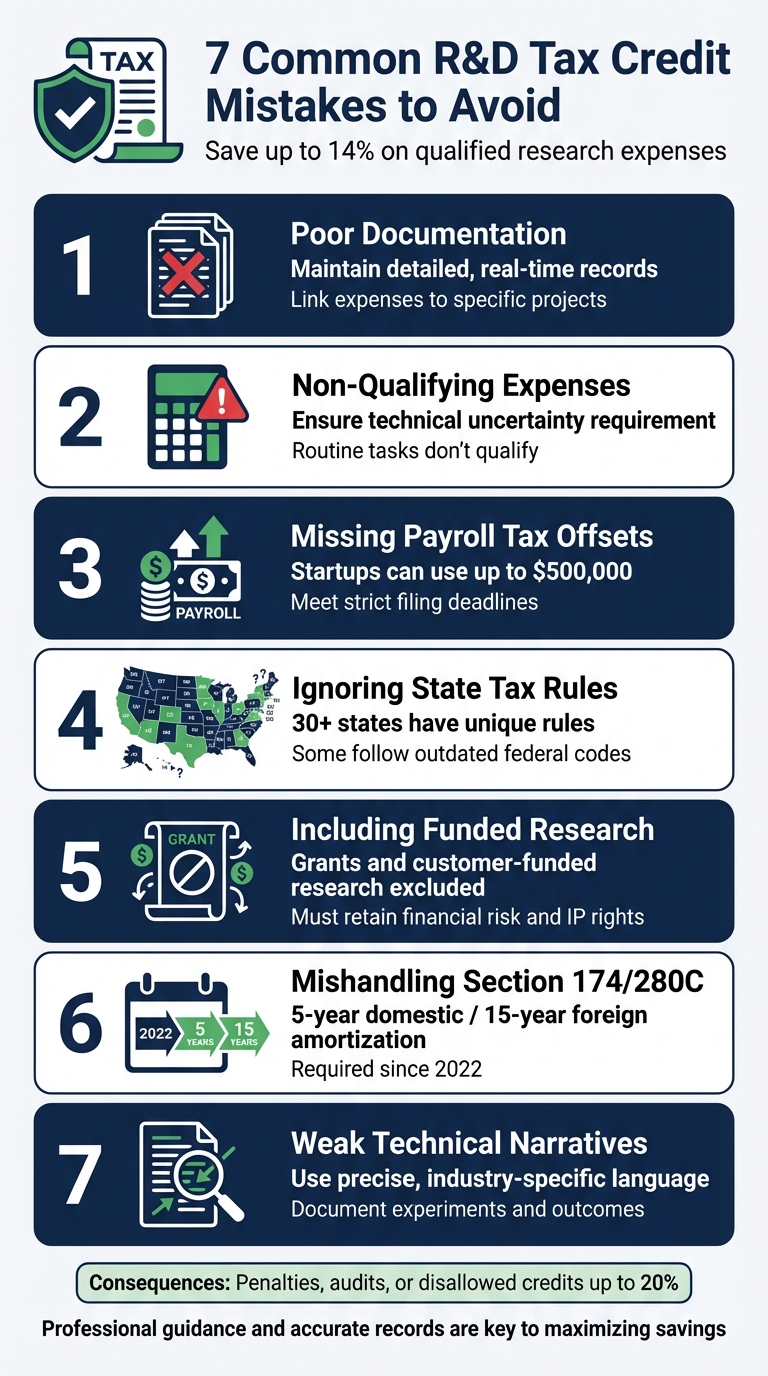
Claiming the R&D tax credit can save businesses up to 14% on qualified research expenses. However, many companies miss out on these savings or face IRS audits due to common errors. To help you navigate this process, here are seven mistakes to avoid:
- Poor Documentation: Failing to link expenses to specific research projects or relying on generic templates can lead to disallowed claims. Maintain detailed, real-time records like lab notes and time logs.
- Non-Qualifying Expenses: Routine tasks, reverse engineering, or post-production costs don’t qualify. Ensure your activities meet the IRS’s technical uncertainty requirement.
- Missing Payroll Tax Offsets: Startups can use up to $500,000 of credits to offset payroll taxes, but only if they meet strict filing deadlines.
- Ignoring State Tax Rules: State R&D credits vary widely. Some states follow outdated federal rules, requiring careful coordination.
- Including Funded Research: Research funded by grants or customers doesn’t qualify unless your company retains financial risk and ownership rights.
- Mishandling Section 174/280C: Since 2022, R&D expenses must be amortized over five years (domestic) or 15 years (foreign). Missteps here can increase tax liability.
- Weak Technical Narratives: Vague project descriptions are a red flag for the IRS. Use precise language to describe experiments, challenges, and outcomes.
Mistakes can lead to penalties, audits, or disallowed credits. Accurate records and professional guidance are key to maximizing your savings while staying compliant. For a step-by-step walkthrough, see our guide on claiming R&D tax credits.
7 Common R&D Tax Credit Mistakes and How to Avoid Them
R&D tax credits: 3 common mistakes explained
sbb-itb-29ec5e8
1. Poor Documentation of Qualifying Activities
When claiming the R&D tax credit, it's critical to back up every dollar with contemporaneous documentation. The IRS places much greater importance on records created during your research activities than on anything reconstructed later. This means you need precise, detailed records that directly tie your expenses to specific research activities.
To meet these requirements, you must clearly link expenses to individual research projects. For example, document which employees worked on each project, the time they spent, and the technical challenges they were working to resolve[8, 11]. Avoid generic descriptions - these won’t cut it. The IRS is increasingly rejecting prepackaged studies that rely on template language rather than reflecting the actual work your team performed.
Keep thorough records for at least six years after filing. These might include lab notes, design drawings, prototype photos, testing protocols, and even documentation of failed experiments. Industry-specific records are also crucial - like code iterations and bug reports for software developers or CAD designs and testing videos for manufacturers.
Starting in 2025, new rules will apply to businesses with gross receipts over $50 million or qualified research expenses exceeding $1.5 million. These companies will need to provide detailed information for their top 50 business components - those representing at least 80% of total research expenses. Under the updated Section G reporting requirements on Form 6765, you’ll need to identify specific individuals involved and describe the discoveries they aimed to make.
Real-time documentation is key. Use separate accounts for research expenses and maintain contemporaneous technical evidence, such as meeting minutes, emails, and Slack communications. This approach will strengthen your position in case of an audit[11, 12].
2. Claiming Non-Qualifying Expenses
One of the most expensive errors businesses make when filing for the R&D tax credit is including expenses that don’t meet the IRS's strict criteria for Qualified Research Expenses (QREs). The confusion often stems from mistaking routine business operations for genuine research efforts aimed at solving technical challenges. This misunderstanding can lead to further complications when trying to define qualifying activities.
The key factor here is technical uncertainty. To qualify, activities must address problems where the outcome isn’t predictable. Tasks like routine quality control, general maintenance, standard testing, or minor product tweaks don’t make the cut. Similarly, reverse engineering or simply duplicating existing products doesn’t qualify. Once a product moves into commercial production, any associated costs, such as post-production activities, are typically ineligible.
Take the case of Siemer Milling Company. In April 2019, the U.S. Tax Court denied over $235,000 in R&D credits for the 2010 and 2011 tax years. The company had claimed these credits for developing new flour products and improving production lines. However, they couldn’t provide evidence of a structured "process of experimentation." The court dismissed their claims as "conclusory statements" that lacked the necessary documentation to prove hypothesis testing.
Additionally, research conducted outside the United States, Puerto Rico, or U.S. territories, as well as projects funded by grants, government entities, or customers - where the company doesn’t bear financial risk - are not eligible for the credit.
Another common pitfall involves wage allocation errors. The IRS emphasizes that you can’t determine an employee’s involvement in qualified research based solely on their job title. For example, if an engineer spends only 50% of their time on qualifying R&D activities, you can’t claim 100% of their wages as QREs. However, the 80% rule offers an exception: if at least 80% of an employee’s time is spent on qualified research, you can claim their entire annual wages. For those below this threshold, you’ll need to carefully track and report the actual time spent on eligible activities.
3. Missing the Payroll Tax Offset for Small Businesses
A lot of early-stage companies involved in R&D miss out on a valuable opportunity: the payroll tax offset. This benefit, introduced under the Protecting Americans from Tax Hikes (PATH) Act of 2015 and expanded by the Inflation Reduction Act of 2022, allows startups to use their R&D credit to offset payroll taxes instead of income taxes. For businesses with little or no income tax liability, this can provide much-needed cash flow.
To qualify as a Qualified Small Business (QSB), your company must meet two key criteria: gross receipts must be under $5,000,000 for the current tax year, and the business cannot have gross receipts from any year prior to the five-year period ending with the current year. Starting with tax years after December 31, 2022, the offset amount doubles to $500,000. This includes $250,000 applied to the 6.2% Social Security tax and another $250,000 to the 1.45% Medicare tax.
"This election is designed to benefit an eligible startup that has little or no income tax liability." – Internal Revenue Service
Timing is everything. To claim this benefit, you must file the election on your original, timely submitted tax return (including extensions). Complete Section D of Form 6765 and attach it to your return. Then, to claim the credit, include Form 8974 with your quarterly Form 941 starting in the next quarter. Filing late or on an amended return? Unfortunately, that means forfeiting the benefit.
If the credit exceeds your payroll tax liability for a specific quarter, the unused portion rolls forward to the next quarter’s employment tax return. However, businesses under common control must aggregate their gross receipts when determining eligibility. Overlooking this step can lead to errors that jeopardize your claim, so it’s critical to stay precise and compliant when navigating the R&D credit process.
4. Ignoring State Tax Rules
Federal R&D credits are just one piece of the puzzle. Over 30 states offer their own credits, each with its own set of rules. Assuming your state automatically aligns with federal regulations can lead to missed opportunities or compliance headaches.
States generally follow one of two tax code models: "rolling" conformity, which automatically incorporates federal tax code changes, or "static" conformity, which locks the rules to a specific version of the Internal Revenue Code (IRC). For instance, California still bases its rules on Section 41 as it existed in 1996. This means that credit calculations can differ significantly. While the federal government reinstated immediate R&D expensing through the One Big Beautiful Bill Act (OBBBA) on July 4, 2025, many states continue to require a five-year amortization period because they haven’t updated their laws. Understanding these state-specific conformity models is key to maximizing your credits.
Take California as an example. It uses a 15% credit rate, lower than the federal 20%. It also prohibits carrybacks (though it allows indefinite carryforwards) and restricts S-corporations, which can only apply one-third of their credit against entity-level taxes. Meanwhile, Pennsylvania requires businesses to apply for credits through the "myPATH" portal and pass a tax clearance check before approval. Some states further limit credits to research conducted within their borders, unlike federal credits, which cover all U.S.-based research.
To stay ahead, consider creating a conformity matrix to track which states follow rolling or static rules. Focus on compliance in key states like California, New York, and Texas, and align state amendments with federal filings to meet each state's statute of limitations. Also, make sure to integrate state credit calculations with your federal filings under Section 174, Section 41, and Section 280C to avoid either overclaiming or leaving money unclaimed.
5. Including Subsidized or Customer-Funded Activities
Not all research qualifies for the R&D credit. According to IRC § 41(d)(4)(H), research funded by grants, government entities, or customer contracts is excluded from eligibility. This is a commonly misunderstood area, and mistakenly including such activities can lead to IRS audits and disallowed credits. To determine whether research is considered funded, the IRS applies a two-part test.
First, determine if your company bears the financial risk. For instance, in cost-plus contracts, where payment is guaranteed regardless of the outcome, the research is classified as funded. Second, check if you retain substantial rights. If you are required to pay to use the developed technology or if the customer gains ownership of the intellectual property (IP), you do not retain substantial rights.
"A taxpayer does not retain substantial rights in the research if the taxpayer must pay for the right to use the results of the research." – IRS Audit Techniques Guide
Carefully review all contracts and agreements for payment terms and clauses related to intellectual property ownership. Fixed-price contracts, where payment is contingent on delivering successful results, may qualify if you retain the rights to use the research in your own business. However, research activities that simply modify an existing product to meet a customer’s specifications do not qualify.
In cases of partially funded research, the IRS enforces a strict pro-rata allocation. Typically, all funding is deducted from your qualified research expenses unless your total expenses exceed the funding amount and qualified expenses surpass 65% of that funding. If funding amounts are uncertain at the time of filing, treat the research as fully funded, and amend your return once the final figures are confirmed.
6. Mishandling Section 174 and 280C Requirements
Navigating R&D tax credits can get tricky, especially when it comes to Section 174 and Section 280C. Since 2022, Section 174 requires businesses to capitalize and amortize R&D expenses - over five years for domestic research and fifteen years for foreign research. This change increases taxable income in the early years. Meanwhile, Section 280C ensures there’s no double benefit by reducing the R&D expense deduction by the credit amount. Alternatively, you can choose a "reduced credit" option, calculated at the corporate tax rate of 21%, which allows you to keep the full deduction.
If these provisions aren’t properly aligned, you may face a tough choice: reduce the expenses capitalized under Section 174 by the credit amount or opt for the reduced credit. Poor coordination could lead to audits or disallowed deductions. Misclassifying research expenses as domestic or foreign is another common mistake, as it affects whether the amortization period is five or fifteen years. Both scenarios can significantly impact your tax liability. It’s essential to address these challenges before exploring relief options.
For qualifying small businesses, there’s some good news. According to Rev. Proc. 2025-28, companies with average gross receipts under $31 million for the years 2022 to 2024 can immediately deduct domestic R&D costs instead of amortizing them. To claim this benefit, you need to attach a statement titled "FILED PURSUANT TO SECTION 3.03 OF REV. PROC. 2025-28" to your tax return. But don’t delay - the deadline for amended returns is July 6, 2026.
"Rev. Proc. 2025-28 provides welcome certainty and a practical path to deduct domestic R&D costs for 2024 under §174A." – Jonathan Tucker and Paul McVoy, Principals, KBKG
When planning your taxes, carefully weigh the decision between a reduced Section 174 deduction and the reduced credit option. Since amortization spans multiple years, modeling your tax position thoroughly is key to making the best long-term decision.
7. Weak Technical Descriptions and Project Records
Vague project descriptions are a red flag for the IRS. If your documentation merely states that the team worked on "new product development" or participated in "technical activities", it won’t cut it. A notable case highlighted this issue when the court disallowed significant credits because the project descriptions lacked detail. The court found that broad, conclusory statements without thorough documentation of the research process were insufficient. This serves as a clear reminder: a well-documented technical narrative is critical. It should detail every experiment, hypothesis, and step in the research process.
To strengthen your R&D tax credit claim, you need more than just comprehensive records - you need a clear technical narrative. While the IRS doesn’t strictly define what counts as “sufficient documentation,” detailed records are non-negotiable [4,5]. Your narrative should align with the four-part test: Permitted Purpose, Elimination of Uncertainty, Process of Experimentation, and Technological Nature. For every project, outline the technical challenges you faced, whether they involved capability, method, or design. Explain why conventional approaches didn’t work [3,8]. Document each step of your process - modeling, simulations, trial and error, evaluation of alternatives - and don’t shy away from including failed attempts, as they demonstrate genuine experimentation [4,16].
"Documentation must be in sufficiently usable form and detail to substantiate that the expenditures claimed are eligible for the credit." – U.S. Court of Appeals, Seventh Circuit
Avoid the temptation to rely on generic templates. Instead, use precise, industry-specific language and keep contemporaneous records - document activities as they happen rather than waiting until year-end. Build comprehensive project evidence folders that include items like lab notes, design drawings, blueprints, prototype photos, and testing records. On the financial side, ensure your accounting records directly link qualified research expenses to specific business components or projects [8,12].
For software developers, documentation presents unique challenges, especially in agile environments. Agile’s rapid sprints (usually 2–4 weeks) can make it harder to document traditional experimentation processes, and the IRS has been paying closer attention to this. Use time-tracking tools to log hours in real time, as retrospective percentage estimates often fall short [5,14]. Additionally, keep the "substantially-all" test in mind: at least 80% of research activities for a business component must involve experimentation. If a large project doesn’t meet this threshold, break it into smaller sub-components and maintain detailed records for those that may qualify under the shrink-back rule.
Comparison Table
The table below outlines common mistakes businesses make when claiming R&D tax credits, paired with practical solutions and the benefits of professional guidance.
| Common Mistake | Effective Solution | How Financial Services Support Helps |
|---|---|---|
| Poor Documentation of Qualifying Activities | Keep detailed, real-time records that link expenses to specific projects. | Professionals set up systems to document both technical and financial details in real time, ensuring compliance with IRS standards. |
| Claiming Non-Qualifying Expenses | Use the IRS Four-Part Test to separate routine work from genuine research efforts. | Experts review activities and expenses to identify qualifying items, minimizing the risk of penalties for overstatements. |
| Missing the Payroll Tax Offset for Small Businesses | Confirm eligibility (less than $5 million in gross receipts and under five years of revenue) and elect the offset on your original return. | Specialists identify opportunities for FICA offsets and ensure the $500,000 credit is applied correctly for startups. |
| Ignoring State Tax Rules | Conduct a dual analysis, as over 30 states offer R&D tax credits with unique rules and carryover provisions. | Advisors coordinate federal and state claims to maximize benefits while managing compliance across jurisdictions. |
| Including Subsidized or Customer-Funded Activities | Exclude research funded by grants, subsidies, or customer payments from qualified expenses. | Financial teams examine contracts and funding sources to ensure only eligible, at-risk costs are included. |
| Mishandling Section 174 and 280C Requirements | Amortize domestic R&D expenses over five years and foreign research over 15 years, per Rev. Proc. 2025-28. | Accountants handle amortization schedules and help manage the cash flow impact of mandatory capitalization rules introduced in 2022. |
| Weak Technical Descriptions and Project Records | Use clear, industry-specific language to document technical challenges, experiments, and even failed attempts. | Professionals craft IRS-compliant technical narratives that align with the four-part test, supporting your claims effectively. |
These solutions not only strengthen your claims but also reduce your risk of an audit. Partnering with experienced professionals ensures thorough documentation and compliance, helping you secure the full scope of tax benefits. John Burcu, Tax Credit Manager at TriNet Clarus R+D, underscores the importance of expert help:
"The best way to help reduce business risk when claiming the R&D tax credit is to work with an experienced R&D tax professional to support your documentation process".
With fewer than 20% of eligible businesses currently utilizing this incentive, getting the process right is crucial.
Conclusion
Claiming the R&D tax credit can lead to substantial savings - approximately 13 cents for every qualified dollar spent. However, those savings come with a caveat: avoiding common mistakes is crucial. One of the biggest issues is poor or untimely documentation. The IRS doesn’t provide a clear definition of “sufficient” documentation, leaving it up to taxpayers to prove their claims. If expenses aren’t directly tied to specific research activities, those costs could be disallowed.
The consequences of disallowed credits can be steep. Companies may face amended tax returns, additional taxes, and penalties of up to 20% for any overstatement. In some cases, businesses have lost hundreds of thousands of dollars in credits due to inadequate records.
To avoid these pitfalls, maintaining detailed, real-time documentation is critical. Records must cover the required look-back period and clearly link expenses to specific projects. As John Burcu, Tax Credit Manager at TriNet, puts it:
"A list of qualified research activities isn't helpful if the costs cannot be traced to specific projects or activities".
These challenges highlight the importance of working with experienced tax professionals. Experts can help ensure your documentation meets IRS standards, navigate Section 174 requirements, and create strong technical narratives. Their guidance not only reduces the risk of audits but also ensures you claim every eligible credit.
Whether you’re a startup using the $500,000 payroll tax offset or an established business carrying credits forward for up to 20 years, careful planning and accurate records are non-negotiable. Without them, you risk audits and penalties. With the right expertise, however, you can stay compliant and maximize your R&D tax credits.
FAQs
What steps can I take to properly document my R&D expenses and avoid issues with my tax claim?
To make sure your R&D expenses are documented properly and to avoid the risk of disallowed claims, focus on maintaining clear and detailed records of your activities and associated costs. Begin by outlining each research project, specifying its goals, technical challenges, and anticipated results. Every expense - whether it's salaries, materials, or contractor fees - should be directly tied to these projects.
Keep thorough time-tracking records for employees working on R&D activities, save all relevant invoices and receipts, and establish dedicated accounting codes specifically for R&D-related costs. Use a secure and well-organized system to store your documentation, ensuring it remains accessible for at least three years after filing. Before submitting your claim, have a tax professional review everything to ensure it aligns with compliance requirements and is accurate.
Taking these steps will help you submit a strong, well-documented claim and make the most of your tax credit opportunities.
What kinds of research activities qualify for the R&D tax credit?
To qualify for the R&D tax credit, your research efforts must focus on developing or improving the functionality, performance, quality, or reliability of a product, process, formula, technique, or software. These activities should be grounded in a hard science, such as engineering, physics, chemistry, biology, or computer science. Beyond that, the IRS requires these activities to pass its four-part test for qualified research.
Here’s a quick breakdown of the four-part test:
- Qualified Purpose: The work must aim to create or enhance a product or process.
- Technological Uncertainty: There should be challenges or unknowns that require resolution through research.
- Systematic Process of Experimentation: The activities should follow a structured approach to testing and problem-solving.
- Permitted Purpose: The research must be conducted within the U.S. for a valid business purpose.
By ensuring your activities meet these standards, you can better position your business to claim the R&D tax credit while staying fully compliant with IRS regulations.
How do state R&D tax credit rules differ from federal guidelines?
Federal R&D tax credits follow a uniform set of rules, including the IRS’s 80% rule. Under this rule, if at least 80% of an employee’s work involves qualifying research activities, their entire wage can be counted as a research expense. This credit directly reduces your federal tax liability on a dollar-for-dollar basis.
State R&D tax credits, on the other hand, are much more varied. Each state has its own rules for eligibility, credit percentages, and whether the credits can be refunded or transferred. For instance, some states may expand the list of qualifying expenses to include specific supplies or capital costs. Others might offer flexibility by making the credits refundable or transferable. To get the most out of these credits, it’s important to carefully examine the rules in every state where your business operates.
Related Blog Posts
Keep reading

Business Tax Preparation Guide: File Accurately
Simplify tax season as you learn business tax preparation essentials step by step. Avoid costly errors and discover deductions, records, and filing tips.

Business Taxes Explained: Filing & Compliance Guide 2026
Master business taxes with clarity and confidence as you learn key filing rules and deadlines. Stay compliant and discover deductions, credits, and smart strategies.
Smart Business Tax Planning: Maximize Profits 2026
Strengthen profits as you learn proven business tax planning strategies year-round. Reduce liabilities and discover deductions, credits, and timing moves.